


In the final hour of the 2020 NFL regular season, the Philadelphia Eagles benched rookie Jalen Hurts at the start of the fourth quarter in the league’s regular season finale on Sunday Night Football. The Eagles trailed the Washington Football Team by three points at the time and had a 23% chance to win, per nflreadr. Washington would make the playoffs with a win, while Philadelphia would slot in at the 6th overall pick in the draft with a loss or the 9th overall pick with a win.
Hurts was replaced by Nate Sudfeld. Sudfeld was the Eagles primary backup behind Carson Wentz in Week 1, but had been a heathy scratch for every game since. He turned the ball over twice in his first five snaps and Washington hung on for a 20-14 win. Sudfeld did not return to Philadelphia in 2021, instead signing a one-year league-minimum deal with San Francisco. Sudfeld is yet to make his first NFL start.
The Eagles would go on to trade the 6th pick to Miami for the 12th pick, a 2022 first round pick, and a small day 3 trade-up. They’d ultimately move up to take DeVonta Smith at 10, who may have been the player they’d draft at 9 if they ended their season with a win over Washington a few months earlier. In the 2022 draft, the Eagles moved up with the Dolphins pick to select Jordan Davis. There were other picks involved, but it is clear that the catalyst of the Eagles adding a key piece to their defense was finishing the 2020 season with a loss.
As spectators, our expectation should be that every team is perpetually working toward achieving short-team goals (winning their next game) and long-term goals (winning the most games possible + winning championships). These are rarely at odds, but when a team is no longer in contention for the playoffs, the incentive to win today may only exist for the purpose of pride and job security of individual coaches and players. That can be a significant motivator, but the Eagles of 2020 showed that it can be tempting for organizations to put a thumb on the scale given the stakes.
I would say there are four broad categories of ways that teams intentionally subvert their ability to win:
Long-term tanking - A team that is not doing everything in their power during the offseason to field a roster that will maximize wins in the coming year. There is a wide spectrum at this level that could include teams that are “retooling” in an effort to get younger while still competing, as well as teams that are ripping their roster down to the studs. Truthfully, I think we sometimes decide which is which after the fact.
Short-term tanking - A team that has lost the incentive to compete in the middle of season and is no longer fielding an optimal roster. This is the tanking that we see most often in the NFL, where teams bench or shut down veterans for the stated purpose of developing younger players. This often has the added effect of improving draft position by piling up losses with a weakened roster.
Strategic Rest - In the interest of covering all my bases, this would be a team that is resting key players to avoid injury or fatigue. This has been a major issue in the NBA regular season for several years, but given the length of the NFL season, it really only comes into play for teams that have locked in their playoff seed prior to the final regular season game.
Deliberate tanking - This is the rare case where members of the organization beyond the front office engage in purposeful actions to lose. I would argue the final quarter of the 2020 Eagles season falls in this category.
The first three categories would be dictated entirely by the front office in most cases. I would be shocked to learn that any player had participated in tanking, and I would think that a coaching staff would only do so if explicitly directed by a front office. It is always worth repeating that players do not lose on purpose. Tanking is a product of the organization sabotaging the team in a way that makes winning less likely.
What is the extent of the NFL’s tanking problem?
In my opinion, tanking is really not as pervasive as some may think. In the NFL, rosters are so big and career & evaluation windows so short that the temptation to lose with the goal of improving draft capital isn’t as strong as it might be in other professional sports leagues.
To demonstrate this, I looked at how playing time changes over the home stretch of a season. I started by looking at the snap shares of all 48 gameday actives for every team in their seventh to last game (Game #11 in the current 17 game season format) going back to 2019. I calculated the R-squared value of those Game #11 snap shares for each team vs the six subsequent games to show just how much rosters are turning over. In plain English, we might say we can explain ~65% (R-Squared of 0.65) of the variance in player’s snap share in Game #12 by looking only at their snap share in Game #11. Our ability to explain the variance with the Game #11 snap share alone decreases as the roster changes with each passing game.
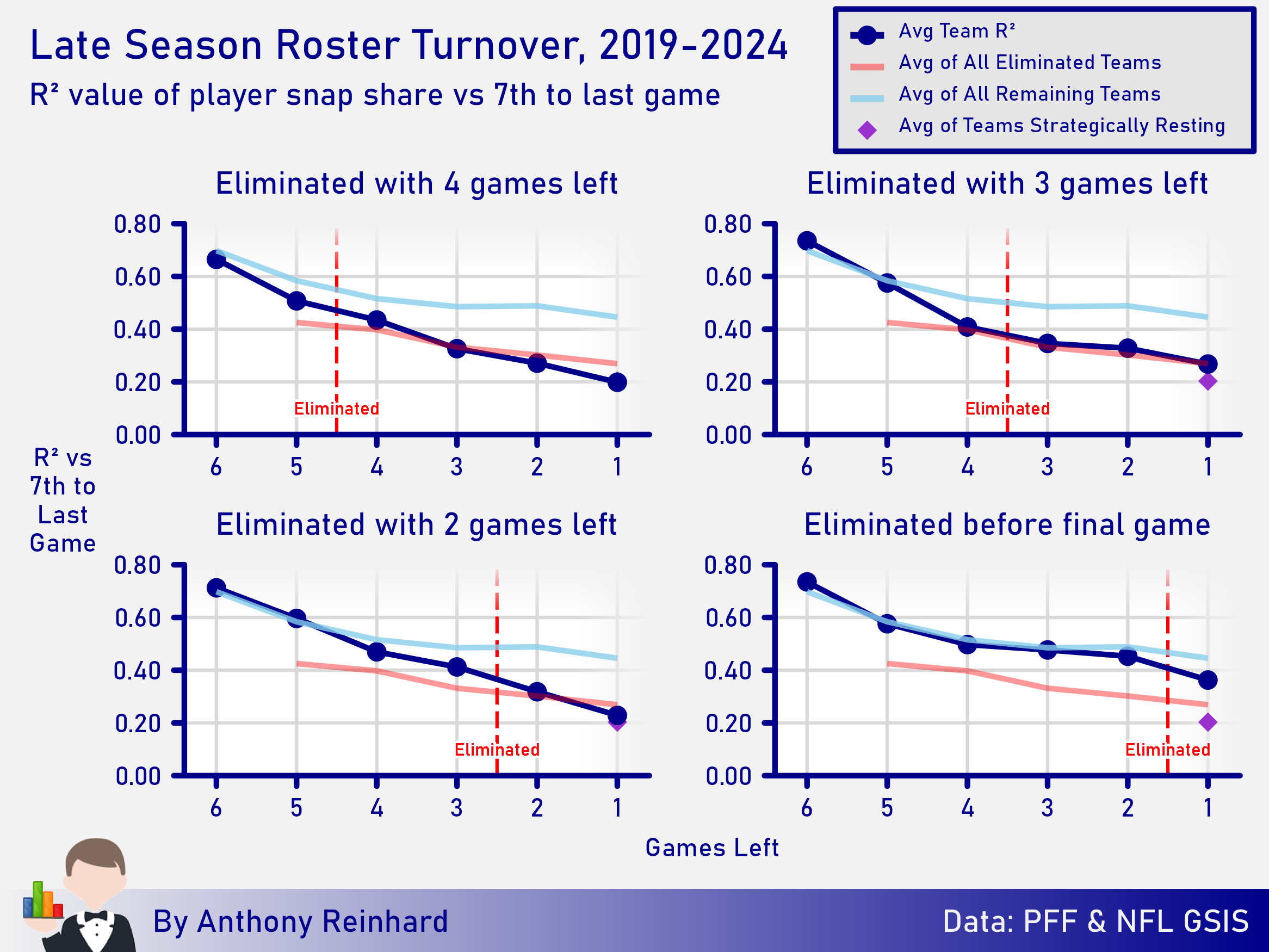
In the four graphs above, I’ve plotted a dark blue line to show how continuity changes for teams in their last six games. The dark blue line appears between a light blue line (teams that are still able to make the playoffs) and a light red line (teams that have already been eliminated). The way the dark blue line drifts toward the red illustrates when teams might start engaging in what I termed short-term tanking earlier, which is to say that they are no longer fielding an optimal roster. I find the graph in the lower right revealing, in that it shows the difference in continuity in the final regular season game between the teams that still have playoff hopes and the teams lost that hope just one week earlier.
The critical thing that I would take away from this is that eliminated teams (on average) tend to gradually cycle contributors out of the lineup as their season ends rather than a wholesale change as soon as their path to the playoff closes. It’s not like a major shake-up is impossible either. The purple diamond in the final game of the season on each graph represents teams that are strategically resting. This was another way that teams behave non-competitively that I called out earlier. In this case, I’ve isolated teams that were previously in the light blue line (not eliminated from the playoffs), but are now in a situation where they’ve either clinched a bye, clinched a division title (and home field advantage in their playoff opener) without any chance to get a bye, or clinched a wild card spot with no chance to win their division. The teams in this category show just how far teams could go in a single week without needing to release players currently on the roster. The typical eliminated team does end up pretty close to this point by season end, but plenty of teams don’t seem rushed to get there.
Whether it is a desire to legitimately develop younger players, manage relationships with veteran players and fans, or simply a point of pride, the NFL and it’s teams do not have a culture where losing with purpose is acceptable. This is great for all parties, but it doesn’t change the fact every front office is aware of the importance of the draft order. NFL franchises face a real cost when they win a game late in the season. It is a contradiction that players, fans, and front offices do not need to accept.
What is my solution?
The primary goal for an anti-tanking framework should obviously be to eliminate the incentive to lose on purpose. At the same time, I think there is a balance that should be struck with the draft order as a device that enforces parity, especially in a league where the top picks are frequently QBs that can single handedly change the direction of a struggling franchise. The league has an interest in giving every franchise the opportunity to succeed after all. The solution should also ideally be simple. The current setup meets that requirement well in a foundational sense: the worse your record is, the earlier you get to pick.
With all that in mind, my solution is loosely based on the Gold Plan, which determines draft position based on performance after being eliminated from the playoffs. This works for leagues that have longer seasons and larger divisions, but in the NFL, teams are eliminated unevenly and often only with a game or two to go.
My method would allow teams to earn draft points over their final 12 regular season games under the following conditions:
Teams with a record at or above 0.500 are awarded 1 draft point for a win and 0 draft points for a loss.
Teams with a record below 0.500 are guaranteed to be awarded points equal to (# of losses entering the game) minus (# of wins entering the game). With a win, the number of points awarded are doubled.
The first tie-breaker places the team with the most recent win at an earlier draft position.
Teams who make the playoffs will continue to be ordered in the same way they are today.
The Strengths
Reduces the incentive to lose - The primary advantage of this system to the current one is that a win improves draft position more than a loss at the end of the season. Here, I’ve plotted the average draft position of teams that ultimately missed the playoffs in the last nine completed seasons based on whether they won or lost in that week.
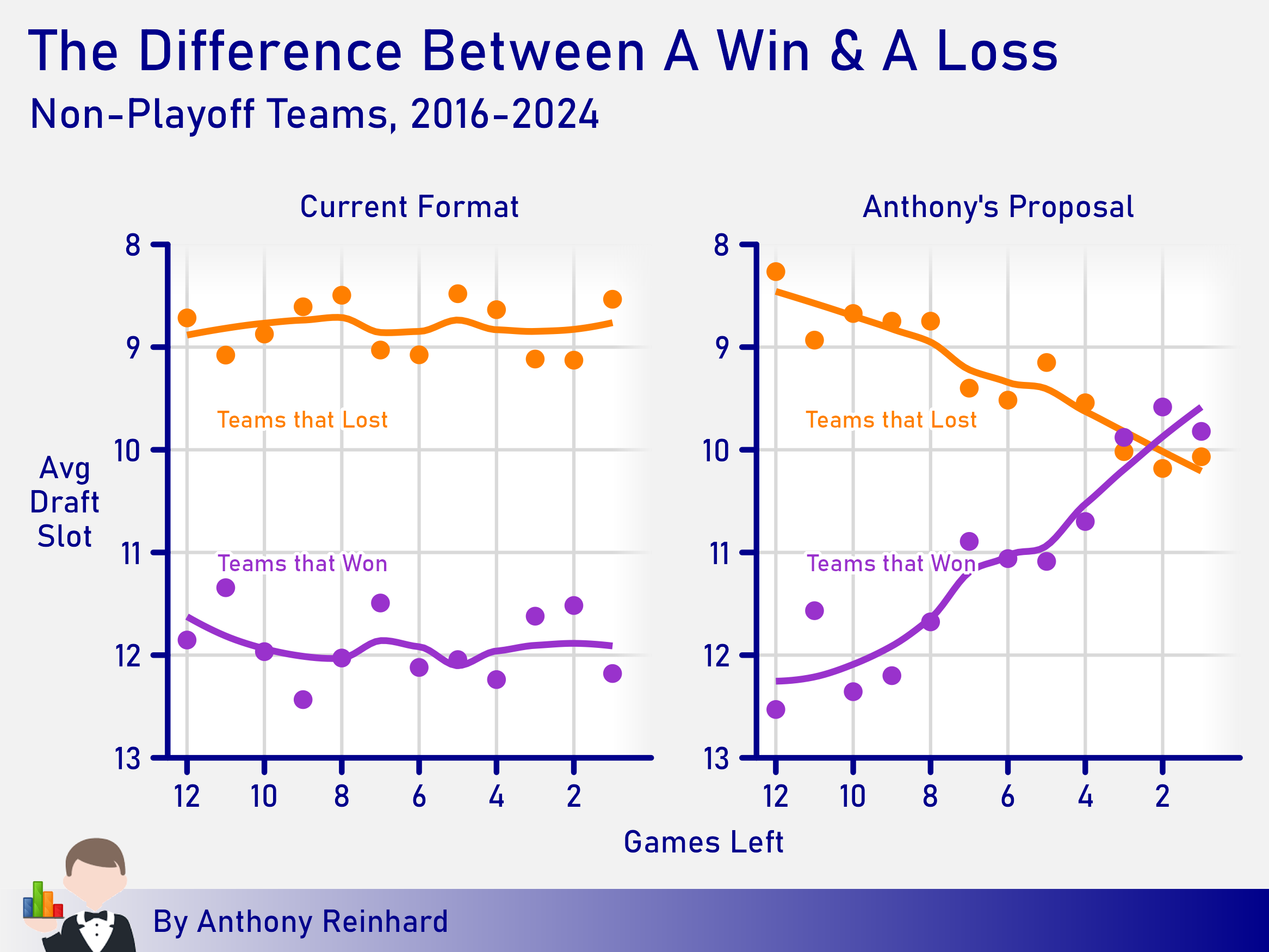
Under the current system, the difference between a win and a loss for non-playoff teams tends to be about three slots no matter when it happens. My system has a similar differential though the first half of the season, but as the season goes on, it eventually helps a team’s draft position to win. The fact that a loss is more helpful than a win for much of the season is a weakness I’ll touch on shortly.
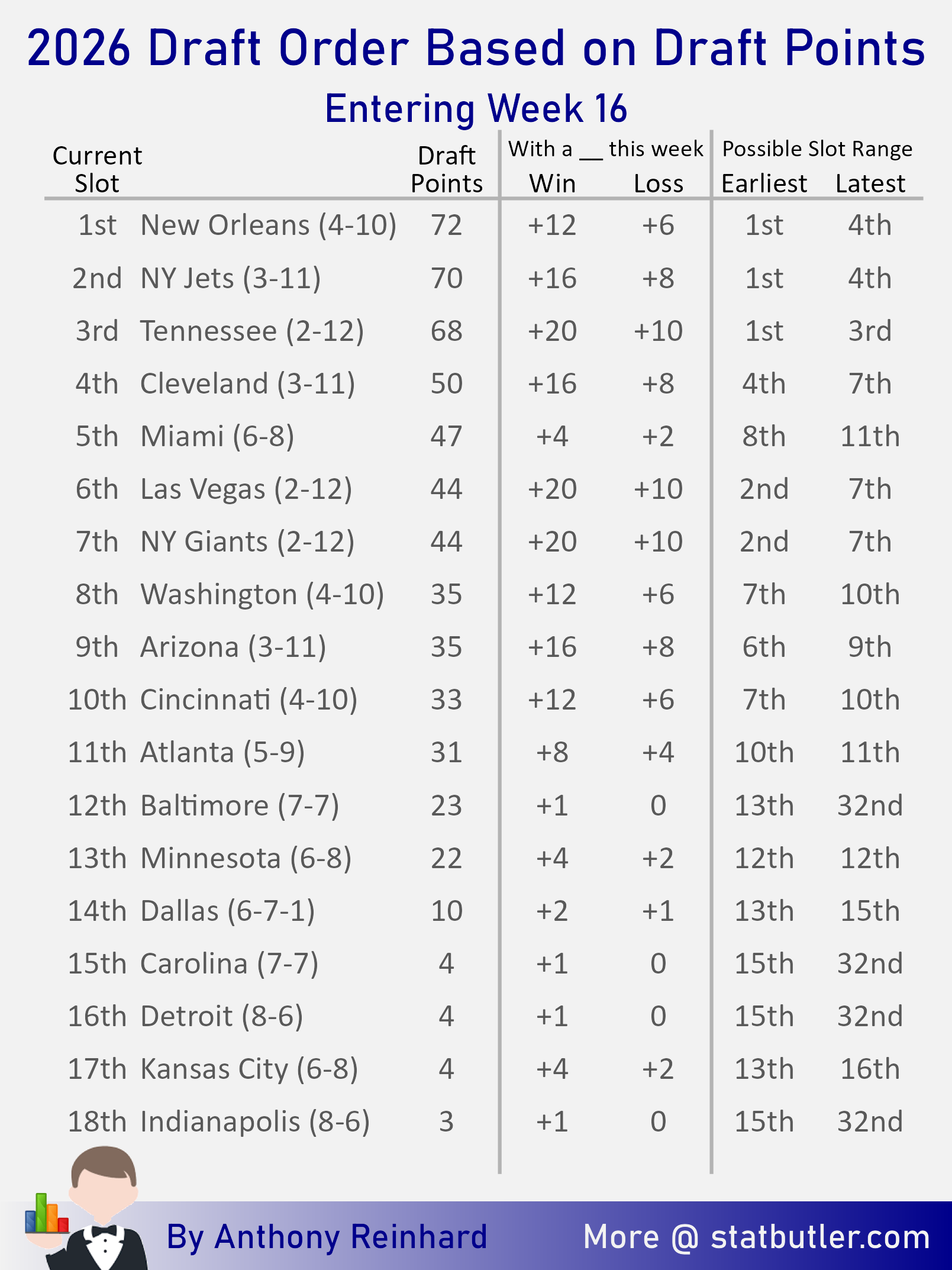
Rewards teams that finish strong - As mentioned in my prior bullet and graph, teams that go on late runs can secure strong draft positions. In my rankings for this season, you’ll find that the Saints (back-to-back wins) and Dolphins (won 5 of last 7) have accumulated enough points to clinch higher picks than they’re slated to have under the current rules.
Preserves some degree of parity - In my view, there is a delicate balance that should be struck between rewarding winners and throwing a life preserver to the franchises that need it. Under my proposal, the Giants & Raiders, both winless since Week 6, could still play their way up to the 2nd overall pick by stacking a few wins, but will both ultimately still pick in the top seven no matter what.
Starts the tabulation early - Plenty of teams struggle to generate real optimism by the middle of the season. With teams starting to earn points in Week 6 or 7, there can be a new set of standings for fans to follow early on.
The Weaknesses
Does not entirely remove the incentive to tank - The graph I shared above reveals that, under my plan, past non-playoff teams would only have received a better draft slot on average by winning in their final three games. In games played before that point, teams might be better off losing, as it creates more potential points to be earned later in the season. I should note though that the benefit of losing under my plan is less than the benefit that teams currently get. It is also true that most teams are doing all they can to makes the playoffs while they still have a realistic path to get there.
Places significance on the ordering of schedule - The league’s annual schedule unveiling generally doesn’t do much to change a team’s overall outlook for a season, but if the league were to adopt any anti-tanking measure that emphasized late season performance, the schedules would surely face more scrutiny.
Coincidental tanking - My format could produce controversy in situations where a team loses their QB early only to return for the final games of the year or has a developmental QB catch fire after failing for the majority of the season.
The 2026 Draft
With three games to go, my method presently has the Saints at the top overall slot after a pair of wins in the last two weeks. While they’re unlikely to hold on to that spot, they wouldn’t move back any further than the 4th pick under my rules.
Look for an updated calculation next week on X or Bluesky. I would love to hear your own suggestions on ways the league could curtail tanking or what I could change about my plan here!
sub’d. this should be getting more attention, best plan yet i’ve seen put forward